


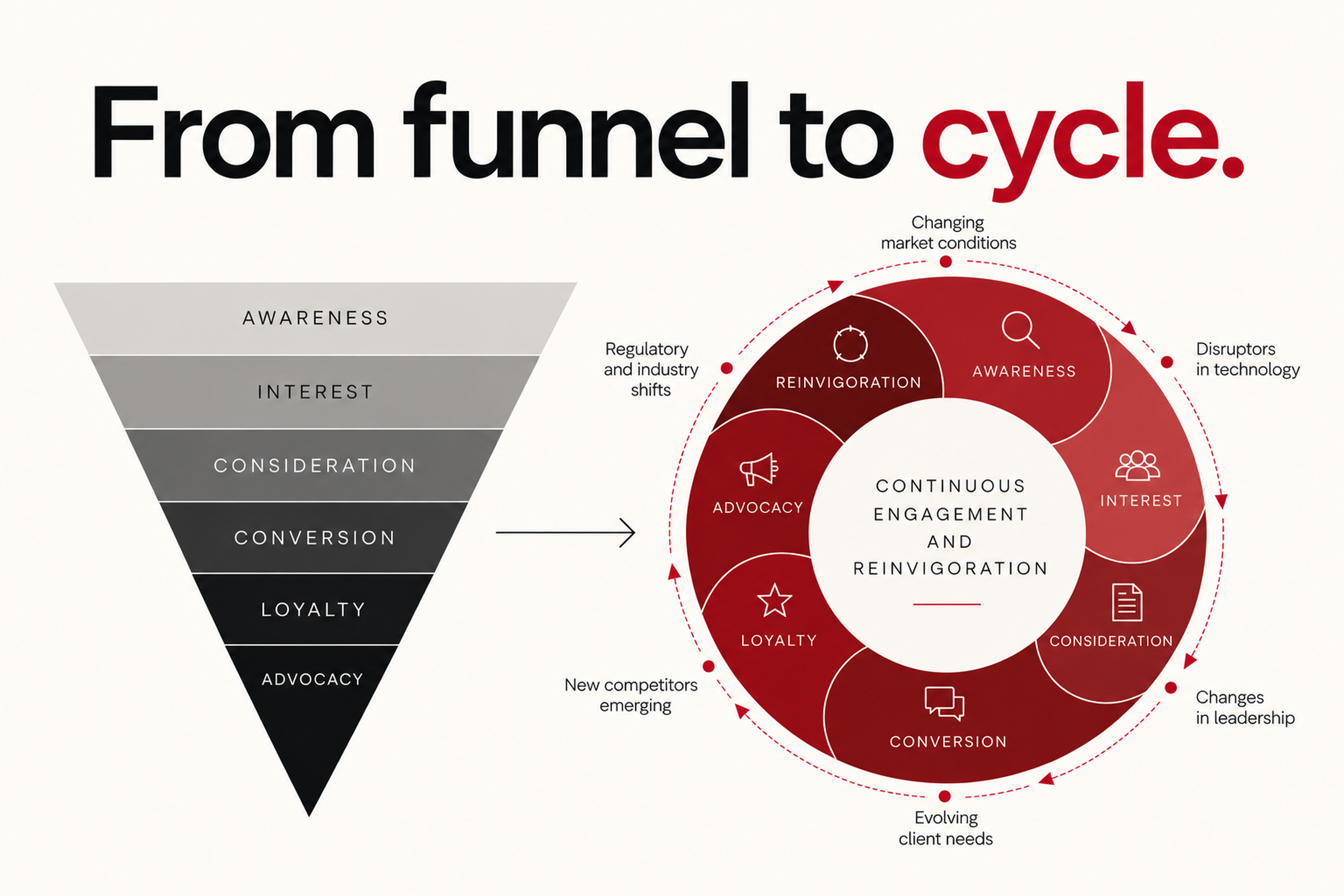
From funnel to cycle: loyalty and advocacy are continually earned.
October 23, 2026
Conversion isn't the conclusion, and advocacy isn't a permanent destination.
Together, they form part of a continuous, non-linear cycle of engagement, nurturing and re-engagement, where relationships evolve, opportunities are reinvigorated and clients continue to discover new value in what a business delivers.
This requires businesses to remain attentive to prospective and existing clients, understand their internal nuances, anticipate changing needs and continually ask questions. It also means finding unexpected ways to surprise and delight, adding value beyond the initial engagement.
Ultimately, advocacy is not the final destination. Even the strongest relationships require ongoing attention, renewed relevance and a continued commitment to earning the trust and loyalty already established.
The funnel maps the stages. The cycle moves in real time.
The traditional marketing funnel provides a familiar framework for understanding the customer journey: attracting attention, building interest, generating enquiries and converting prospects into clients. More developed models extend this journey beyond conversion to encompass retention, loyalty and advocacy.
It offers a structured way to examine how relationships progress, where opportunities emerge and where prospective clients disengage.
But commercial relationships rarely unfold in such an orderly sequence. More importantly, loyalty and advocacy are not permanent states that clients reach and remain in.
Competitors emerge, expectations change, new technologies disrupt established ways of working and business priorities shift. A client who advocates for a business today may reconsider that relationship tomorrow. Continued engagement and loyalty cannot be assumed. They must be continually earned.
Consider an existing client with whom a firm has enjoyed a longstanding relationship. Has the relationship owner remained across changes in the client's business, anticipated emerging challenges and recognised shifts in the broader commercial environment? Is a leadership transition on the horizon, and has the firm established meaningful relationships with other decision-makers to ensure continuity beyond a single contact?
Research reinforces the importance of looking beyond individual contacts. Forrester's State of Business Buying 2026 found that a typical B2B buying decision involves 13 internal stakeholders and nine external influencers. While these figures relate to purchasing decisions rather than ongoing account management, they highlight the breadth of relationships and competing perspectives that can influence commercial decisions.¹ A change in leadership, evolving business priorities or new competitive pressures can quickly alter the dynamics of even the strongest client relationship. Without continued engagement and an understanding of what lies ahead, a firm risks losing relevance or overlooking opportunities to provide further value.
Conversely, anticipating these changes, broadening relationships across the organisation and proactively introducing relevant expertise can strengthen trust, uncover new opportunities and sustain the relationship over time.
The funnel depicts progression through stages. The cycle recognises that relationships evolve, pause, deepen and sometimes change direction entirely, with each interaction offering an opportunity to build on what came before.
Evidence behind the shift: Why a cyclical mindset matters more than ever
Buying behaviour is neither linear nor entirely predictable. Gartner describes B2B purchasing as a series of interconnected activities, including problem identification, solution exploration, requirements building, supplier selection, validation and consensus creation.² Rather than progressing neatly through these stages, purchasing teams frequently revisit earlier decisions as information, requirements and organisational priorities change.
As Gartner observes that The B2B buyer's journey is not a linear process.²
More channels, greater expectations and fragmented attention
McKinsey's 2026 Global B2B Pulse survey, drawing on nearly 4,000 decision-makers across 13 countries, found that B2B buyers use an average of ten channels throughout the purchasing journey.³ The research also identified inconsistent information and inadequate support as important contributors to clients switching.
The significance of these findings extends beyond the number of channels involved. Greater visibility does not necessarily translate into greater influence, particularly when interactions are fragmented, repetitive or fail to deliver meaningful value. The challenge for businesses is not simply to be present across multiple touchpoints, but to create a connected experience that remains relevant as buyer needs and circumstances evolve.
Rather than treating each interaction as an isolated step towards conversion, businesses can recognise how successive engagements contribute to an evolving relationship, creating opportunities to maintain relevance, renew interest and demonstrate value throughout the buying journey and beyond.
Retention deserves the same commercial attention as acquisition
Harvard Business Review summarised historical research suggesting that acquiring a new customer can cost between five and 25 times as much as retaining an existing one, depending on the industry and study.⁴ The same article references Bain & Company research indicating that a 5% improvement in customer retention rates can be associated with profit increases of 25% to 95%.⁴
A 2024 Harvard Business Review article, Toward Healthier B2B Relationships, further examines the importance of understanding relationship health to reduce churn and identify opportunities for account expansion.⁵ This highlights the need to consider whether clients continue to realise value after the initial engagement, rather than assuming that satisfaction, loyalty or future business will follow automatically.
For professional services businesses, this is particularly relevant. A successful engagement may create opportunities to introduce complementary expertise, address emerging challenges or broaden an existing relationship. Equally, a lack of continued attention can allow previously strong relationships to weaken.
Nurturing should therefore extend beyond prospective clients. Keeping established clients informed, sharing relevant insights, anticipating future needs and occasionally delivering unexpected value can help sustain the relationship beyond the original scope of work.
The same principle applies to advocacy. A satisfied client may recommend a business to colleagues or industry peers, introducing entirely new prospects into the cycle. However, referrals should not be treated as an automatic consequence of a successful engagement.
Taken together, the evidence reinforces the need to move beyond linear assumptions about acquisition, conversion and loyalty. Buying behaviour is unpredictable, client expectations evolve, and even established relationships require continued attention. A cyclical approach recognises that engagement, retention, advocacy and reinvigoration are interconnected, requiring businesses to anticipate changing needs, continually demonstrate value and create opportunities for renewed engagement, referrals and growth.
Key metrics to measure across the cycle
1. Anticipation rate: Are we identifying client needs before they become enquiries?
Measure the proportion of new client opportunities identified proactively through industry research, strategic conversations and emerging market developments, rather than through an incoming request.
A related measure is the time between identifying a relevant market disruption and initiating a meaningful client conversation.
2. Client knowledge gap: How much do we actually know about our clients?
Measure the percentage of key accounts with current intelligence on strategic priorities, competitive pressures, leadership succession, regulatory exposure and emerging challenges.
More revealingly, track how frequently material changes in a client's business are discovered only after they have occurred, rather than anticipated through ongoing engagement.
3. Relationship concentration risk: Would the relationship survive if one person left?
Measure the proportion of key accounts dependent on a single contact or relationship owner, alongside the number of meaningful connections established across different levels and functions of the client's organisation.
A commercially valuable relationship may also be structurally vulnerable. Revenue alone will not reveal that exposure.
4. Unprompted value creation: Are we delivering value clients haven't asked for?
Measure the number of proactive insights, relevant specialist introductions or commercially useful recommendations delivered without an immediate sales request.
Importantly, track the proportion that clients acknowledge as useful, act upon or develop into further discussions. The measure is not how much advice a firm distributes, but whether it creates demonstrable value.
5. Relevance decay: How quickly are relationships losing momentum?
Measure the time since the last substantive, client-relevant interaction, changes in engagement among previously active accounts and the proportion of relationships showing sustained declines in meaningful contact.
A client may continue purchasing services while gradually disengaging from the broader relationship. Identifying that change before renewal or retention is affected is commercially significant.
6. Cross-service opportunity recognition: Are we connecting client needs with the firm's wider expertise?
Measure the proportion of emerging client needs that are recognised, referred to appropriate specialists and developed into meaningful conversations.
Track opportunities identified across service lines, introductions accepted by clients and subsequent commercial outcomes.
The objective is not to increase the number of services sold indiscriminately, but to understand whether the organisation is recognising opportunities to solve problems beyond the scope of its original engagement.
7. Advocacy durability: Are we continuing to earn the confidence of our strongest advocates?
Measure how client sentiment, engagement and referral activity change over time, particularly among established advocates.
Consider the proportion of previously active advocates who have stopped making introductions, reduced their engagement or begun exploring alternatives.
Advocacy should be treated as a relationship signal that can strengthen or weaken, not a permanent classification.-These measures are not intended to replace conversion rates, pipeline contribution, retention or revenue. The above reveals what commercial performance that conventional reporting may overlook.
Some require qualitative judgement, disciplined CRM records and agreed definitions rather than automated dashboards. A proactive conversation, for example, should only count as value creation when there is credible evidence that it addressed a relevant client need.
The funnel tells us whether we converted the client. The cycle asks whether we saw change coming, understood what mattered, acted before being asked and continued to deserve the relationship.
That is a different standard of marketing effectiveness.
From funnel to cycle: The bigger, sustainable picture
A cyclical approach recognises that relationships evolve alongside changing markets, technologies, leadership and client priorities.
It seeks to understand clients, ask informed questions, anticipate emerging needs, connect them with relevant expertise and proactively reinvigorate existing accounts.
Reinvigorating relationships requires looking beyond what clients explicitly communicate, recognising the challenges they may not yet have articulated and identifying opportunities to deliver value before being asked.“The most important thing in communication is hearing what isn't said.”– Peter Drucker, management thinker.
Book a time to speak to a Hume Marketing Co. consultant.
-
References
1. Forrester (2026), State of Business Buying 2026.
2. Gartner (2019), Sync Sales Pipeline Management to the B2B Buying Journey; Gartner (2024), Improve Digital Engagement to Support B2B Buying Journeys.
3. McKinsey & Company (2026), The Surprising Economics of B2B Growth: The New Survival Threshold and What It Takes to Thrive.
4. Gallo, A. (2014), The Value of Keeping the Right Customers, Harvard Business Review, summarising historical research including Bain & Company findings.
5. Hochstein, B., Voorhees, C., Johnson, R., McCoy, N. and Mehrotra, V. (2024), Toward Healthier B2B Relationships, Harvard Business Review.